
Introduction: Why AI Agents Matter Now
Prior to 2023 nobody heard of AI agents. Basically, they were not even around then. They were science fiction seen in Star Trek or other futuristic dramas. From 2023 and 2024, when “real” AI came out, AI Agents became a “thing”, and they started to be deployed typically, by large businesses and organizations that relied heavily on automating simple workflows and cutting costs. In 2025, these agents are now mostly deployed in the form of AI receptionists to carry out the following: –
- 24/7 Call answering
- Appointment booking
- Appointment follow up
- Customer service
- Lead follow up
- Customer review follow up
- Overdue invoice payment follow up
- And many more
The accuracy and user experience delivered by these agents is nothing less than amazing. Many people that interact with them are not even aware that they are not talking or dealing with a real person and often, the results achieved can be better than what a human can achieve. AI receptionists are always polite, never rude, always understanding. They are efficient and goal based, where they get the job done in a virtually perfect manner, every time.
Why is this Important?
All this is important because we are living in an age of intense competition from company to company. Just one AI agent that is deployed in one business can effectively carry out the work that would otherwise take 1 – 3 people to achieve. Real world case studies prove the agents to deliver significant cost cuts that often result in, improved workflow and customer satisfaction.
The next two or three years will see a mass uptake of these agents by companies around the world from a solo operating mechanic through to a dental Practice or small office businesses to large corporations. Those that don’t adopt this new technology will still remain a viable business for a time, but their profits will be hit because their competition will likely be in a position to reduce their prices and win more business. This all sounds like a recipe for failure for those that don’t adopt in the long run.
AI agents are often being deployed to assist or replace human receptionists. The ability, performance and efficiency make an agent a “no brainer” so to speak. It is only down to ignorance of the technology, that every business hasn’t adopted this, but that day is fast approaching.
It is not just human receptionists that the AI can replace and outperform. Right now, millions of businesses currently use, a menu-based phone answering system. We have all encountered them and everyone hates them. These menu-based system are annoying for the caller; they are completely impersonal and provide a poor user experience. An AI reception agent would at worst do just as well as the menu-based system but likely do far better. After all, a menu-based system assumes the caller knows what department they need, whereas an AI agent would be able to confirm this and direct their call accordingly.
It is true to say that’s any business that currently uses a menu-based phone answering system is now running an antiquated reception system.
Is an AI Agent a Chatbot?
Simple answer, an AI Agent not a Chatbot. Some of the tasks it carries out maybe similar to what a chatbot does, but they are worlds apart. It is like comparing a beginner tennis player with a professional. Both can play the sport, but the Professional can look at one or two steps ahead of the game and hit the ball accordingly, whereas the beginner struggles to even hit the ball. In the same way, a chatbot has no knowledge of anything and it cannot deviate from its programmed response. An AI agent on the other hand uses rational AI, which means it can process information and determine the best route to proceed to achieve its objective. Basically, it is an electronic brain that thinks like humans might think.
- A question is presented to the AI
- The AI assesses the intent of the question
- The AI provides an answer to that question based on its knowledge and prompt programming
The Core Components of an AI Agent
Goals and Objectives
An AI agent is only as good as its prompt engineering and knowledge base. In the same way, a car’s engine’s performance it’s very much dependent on how it is built. Missing parts or poor-quality build will result in an engine that either doesn’t work or has poor performance.
Not all AI agents are the same. Here at the office manager AI, we see bad prompt engineering and minimal knowledge base that other AI agent providers have created. They will likely give the industry a bad name, which is unfortunate.
At the office manager AI, we realize that in depth prompt engineering and a comprehensive knowledge base are Key to creating a highly proficient agent that gets things that it is tasked to do, done accurately, efficiently and professionally.
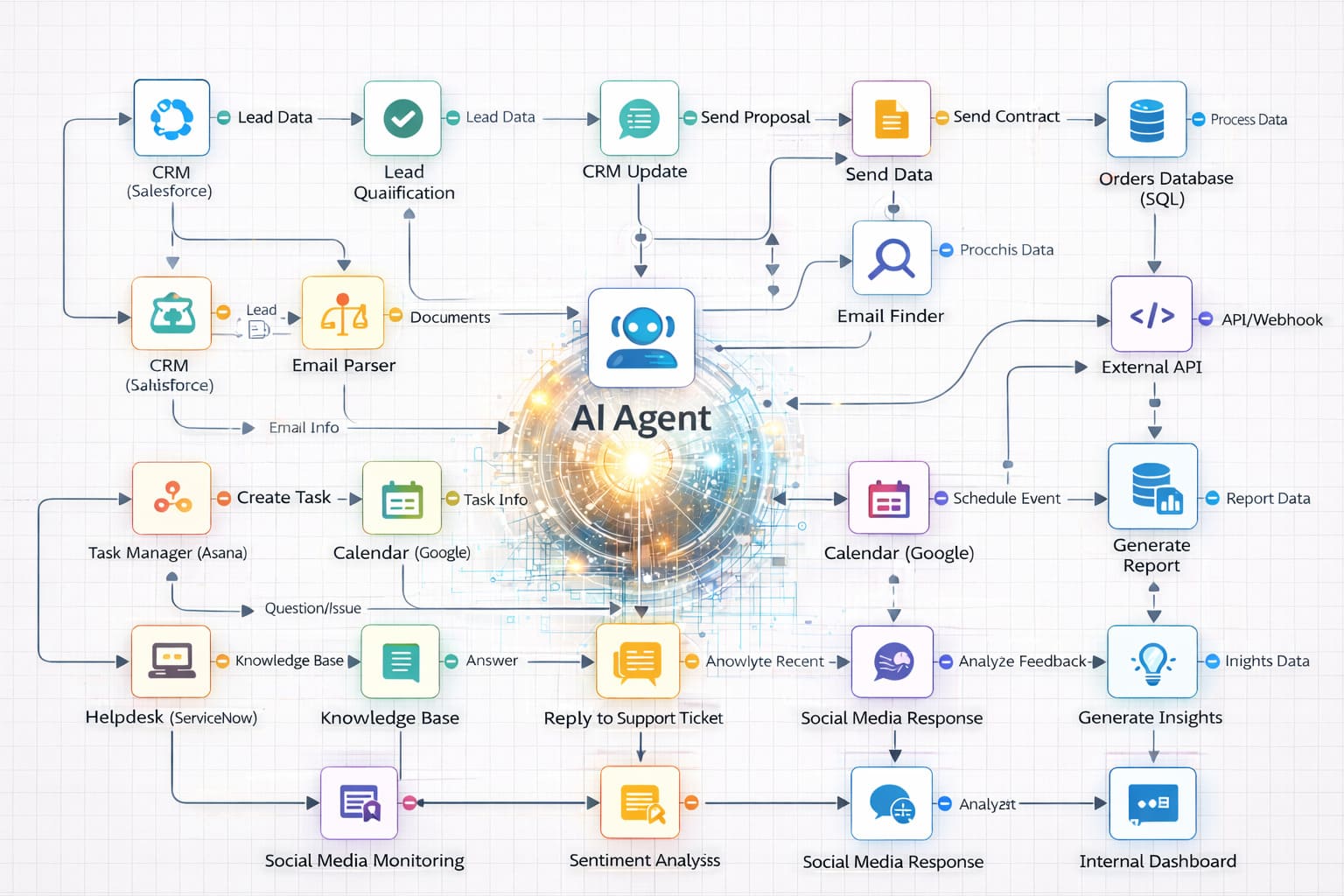
An AI agent can have many different goals and objectives. Complex systems can involve huge workflows as shown in the diagram below, whereas an AI receptionist that is programmed to carry out minimal functions would be far less involved.
Environment
The environment for an AI agent is any place or anything that it has access to, to interact with. This is its world in which it lives (so to speak). Without an environment, the agent has no function. The environment is defined by the programmer, and the bounds are clearly defined.
Modern agent environments are now mostly digital and include websites, phone systems, CRM’s, calendars, internal databases, messaging platforms and APIs. The agents connect all of these together. Anything that the agent has access to, including very basic things such as monitors, printers and basic data sources form the environment in which the agent operates.
The environment defines the following: –
- The information the agents can access
- The actions that the agent is allowed to take
- The rules and constraints that it must follow
Most AI agent environments are deliberately restricted to be basic in functionality. The main reason for this is often down to human fear, where decision makers lack the required confidence in AI to carry out the work that humans have previously done to the standard that they require. Truth is, in many ways, the agents can surpass human accuracy and ability.
An AI agent is most efficient for a business that gives it a huge environment where multiple tasks are in place for it to carry out. Nevertheless, even basic small environments such as a simple AI receptionist can provide a business with an improved efficiency, increased income and a more streamlined business.
Perception
Perception is a term for how an AI agent receives information. The information is provided within its environment. Each input of information is a “perception”, and it is these perceptions that allow the agents to understand what is happening within its environment and what it should do next.
Common forms of input include: –
Voice: These include
- Phone calls
- Transcriptions
- Voice notes
Text: These include
- Emails
- Messages
- Former subscriptions
Data: These include
- CRM information / records
- Time stamps
- System events
- User behavior
The task of an agent is to be alert at all times. It is required to take immediate action when a Trigger is activated.
For Example: –
- An email arrives in a designated inbox that is within its environment. The agent reads the email, understands the content and takes appropriate action.
- The phone rings, the agent answers the call, determines the intent of the caller and takes the appropriate action, such as booking an appointment or directing a call to a specific member of staff, or simply answering a customer support question.
- A form is submitted or the value in a database changes. Anything that the agents is connected to within its environment, it is waiting for something to happen and to determine the appropriate action to take according to the information it receives.
Like a human, the AI agent requires detailed input, or information in order to provide an accurate response. This should not be surprising. If you wanted a decorator to paint your lounge and your instructions were: –
“Paint the walls, ceiling and woodwork”
If that is all the information you provided, the likelihood is that the result would not be what’s you are hoping for. Maybe you want it pink walls and white skirting and the decorator provided light green walls with dark green skirting. The problem will have been down to the input, or the information.
This is obvious, and of course, you would never give such lame instructions to your decorator. In the same way, programming an AI agent requires complex, well thought out and thorough instructions.
AI is very dependable and able to carry out the best results based on the information that it has received. The inputs quality therefore matters very much. For this reason, elaborate detailed prompts, clearly define triggers, data sources and knowledge base are essential for the agent to work with.
Actions (Outputs)
Actions are what separates simple AI systems from an AI agent.
Basic systems generate text or answers whilst an AI Agent is designed to carry out functions. It is programmed to take action within its environment, and those actions are based on the program’s goals, and context that it receives from the inputs.
Examples of actions include the following: –
- Triggering specific workflows or automation
- Sending emails, SMS messages or notifications
- Booking appointments
- Following up leads
- Following up enquiries
- Creating tasks
- Creating reports
- Triggering external API’s
- Updating CRM records
Actions are huge for the business. The agent actions are what forms its usefulness. They allow the agents to read the data, analyze it and take the appropriate action. The actions allow it to influence systems within its environment and produce a real-world outcome without having constant human involvement.
It is the ability for an agent to perceive inputs and then reason about them and then to take meaningful, appropriate and accurate action that makes them so powerful for businesses today.
How AI Agents Make Decisions
The main difference between an AI agent and static automation or simple AI tools is its ability to make an accurate, processed decision. The most basic of agents rely on “if this then that” rules. In other words, “if X happens do Y”. No reasoning is involved here. It is a basic action from a determined input.
More complex agents are able to use reasoning, where an input or question is posed and the agents is required to consider the response. Like the human brain, the AI considers various plausible responses in just fractions of a second and delivers the most logical response according to its prompting, knowledge base and learned behaviour.
The AI agent isn’t blindly responsive. Any input, data or question it receives, it weighs up together with information that it has within its environment and what it has learned from its interaction from various parts of the environment. For example: –
- Who is the user
- What has already happened
- What is the time of day
- What were the previous interactions
- What is the current system state
This level of processing enables decisions to feel coherent and intentional and not purely random.
Some agents are programmed for actioning probabilities. This is where the AI carries out what it calculates to be the most probable outcome to the input. An example in human terms might be where a trader decides to place funds on Gold where the news and indications show signs that Gold is gaining ground. Such a decision is based on probabilities. In situations that require probability assessment, the AI agents will 100% always make the most logical response without error, whereas a human is fallible to error of judgment, calculation or simple mistake.
This level of decision making is what makes an AI agent so much more than just automation. Basic automation carries out the same process day in day out, whereas an AI agent will reason and assess. It will adapt to the input it receives and prioritize where necessary.
AI Agent vs Chatbot: How they differ
AI agents and chatbots may seem to be the same thing too many people, however, they are worlds apart. A chatbot is purely reactive. It’s waits for an input and responds according to its preset guidelines. These guidelines are either keyword-based or basic AI that answers from a simple knowledge base. Typically, the chatbot presents the visitor with a few options to select in order to proceed to the next step and the whole interaction has a 100% mechanical feel to it.
Interactions with chatbots are isolated, and once the answer is given, the chatbot stops. This provides a very minimal and poor user experience.
AI agents on the other hand are basically a three-dimensional chatbot. They can answer the input, in far greater depth and detail than the chatbot can. However, they can then go on to carry out one or more additional steps depending on how it decides the next appropriate steps should be taken. In other words, there is an intelligent process between the initial input and the next step/s that it carries out.
AI agents do, however, require a thorough and professional setup. The setup must include: –
- Clear goals
- Guard rails
- Proper configuration
- Detailed prompts that cover all aspects and eventualities
- Comprehensive knowledge base
Agents that do not get programmed properly in any of these points will not function or behave correctly or efficiently.
They can struggle with ambiguous input, or where there is incomplete data to make accurate decisions or ethical judgment. For this reason, it is essential that human oversight is present, especially where agents deal with sensitive or high impact detail.
It is important to understand these limitations when you are considering automating workflow within your own business or organization. There are limitations and it is important that you have realistic expectations and ensure that your consultant designs your AI agent responsibly. A good AI consultant will be able to advise the most efficient and accurate workflow for your organization. It is the balance between human oversight and AI automation that is important to get right.
Week by week we see an increase in the adoption of autonomous workflows, where these agents manage complete end-to-end processes and have minimal human inputs. When done correctly, the result is amazing, producing increased output and profitability for the organization. One of the main benefits are the huge cost cuts that are achieved.
Real world case study examples that our team at The Office Manager AI has achieved for just a couple of businesses are remarkable (details below): –
If you are considering AI automation for your business, we are happy to talk to you without obligation. This would help you get a better understanding of how and where AI could help your business.
The Future of AI Agents
Right now, small business is increasingly adopting simple AI agents to handle calls and appointment booking. The future will continue to grow as more and more businesses see their competition benefit from these agents.
Corporations and larger businesses have already been implementing automated workflow increasingly over the last few years. Right now, the sophistication of AI technology, adoption will continue to escalate. This escalation will also see more complex workflows where the complexity will increase as the technology and ability grows.
The most common use of AI agents is an AI receptionist. These are the most basic of digital employees and we will see AI branching into more and more defined roles and responsibilities. Many jobs that until now have relied on human input will at some stage, be replaced by digital employees.
We are at the moments in history where the majority of businesses either don’t know about AI agents or they are looking at them with uneducated interest. For most business owners, until they actually see AI working for their business, they will do nothing. For those that take the step and adopt this technology right now, those businesses will have an advantage. The phrase, “the early bird catches the worm” comes to mind.
Conclusion: Why it is Important to Understand AI Agents
AI agents are here to stay. They will only increase in popularity and ability. They are not a fad or a trend. They represent a shift in world business order where earlier adopters will certainly get an advantage. Right now, at this time in history, we are in the “Gold Rush” stage. Once all the other businesses and organizations have caught up, there will no longer be any advantage, everyone will be gaining the same advantage. Those that don’t adopt automation run the risk of extinction or at best, losing ground and falling behind.
Free Consultation
I mentioned it a couple of times in this article, but if you would like a free consultation to discuss how AI automation can be deployed in your business or organization where we go over what is not possible and what is not possible, please talk to Emily, support agent on this site. You find in the bottom right corner of the page. Just click the talk button and chat with her to arrange an appointment.