
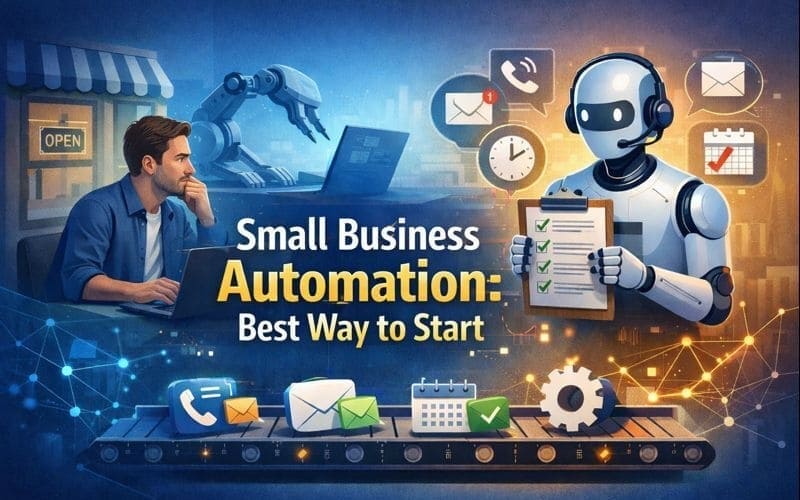
Automation for business is not a new thing. Automation first started at scale in the 18th century where machinery was used in the textile industry. Since those days, the world has moved on and progressed with automation at a staggering rate where this is concerned.
Automation is something that all businesses will adopt at some stage in the near future. The majority of those that don’t, simply won’t remain viable and may struggle to survive. We are not at that stage just yet, but we are fast approaching it.
Automation is a topic that businesses are increasingly talking about and looking into. However, for many small to medium-sized business, the thought of automating their business feels intimidating and risky. For others, the thought has not even crossed their mind, because they are not even aware of the potential to automate aspects of their business.
Hesitation Towards Small Business Automation
A hesitation towards small business automation is understandable. After all, when you build a business, you build it following steps and processes that you are familiar with. What ends up working for you, you tend to stick with, and the thought of automation just seems too risky for many business owners because the typical consensus is that they don’t want to give up control.
Here’s the thing though, automation is not about changing the way you do your business or replacing people or even changing the way that your business feels. No, it’s all about capturing things that get missed and ensuring that the business flows more efficiently and that the customer experience is elevated. All of this can be provided from a well-planned out automation.
The key is not whether you should automate, but how you can do it safely, gradually and profitably.
Automation is not allowing technology to take over your business. It is there to help you, while you remain 100% in full control of your business.
Why Small Businesses Are Often Reluctant to Automate
The main resistance business owners have to automation is fear. The idea of automating aspects of the company’s workflow sounds great. However, the fear of losing control as well as misconceptions often put people off, is understandable, yet a shame at the same time.
These are just some of the most common concerns: –
- “I don’t want a robot talking to my customers”
- “What if it gets things wrong?”
- “It’s not possible to automate my business”
- “It all sounds too complicated”
- “I don’t have the time to learn about the setup”
- “Automation sounds way too expensive”
- “I’ve tried different software’s and most of them don’t deliver as promised”
All of these concerns are completely understandable. I would have the same concerns if I didn’t understand how the automation works. Many people think that you have to learn about running complex dashboards with elaborate settings. The thing is, that is not the case, and it doesn’t apply to automation. In actual fact, small business automation is so simple, and the learning curve is virtually non-existent. However, the benefits are huge.
Another concern regarding small business automation comes from an emotional aspect: Loss of control. When your reputation hangs on customer experience, anything automated could understandably feel like a threat. Although this is understandable, it is a wrong impression. A well put together automated workflow for your business will improve the customer experience and improve your reputation, not the other way round.
Automation, when done correctly, doesn’t remove control. It adds if efficiency as well as consistency.
The Hidden Cost of Ignoring Small Business Automation
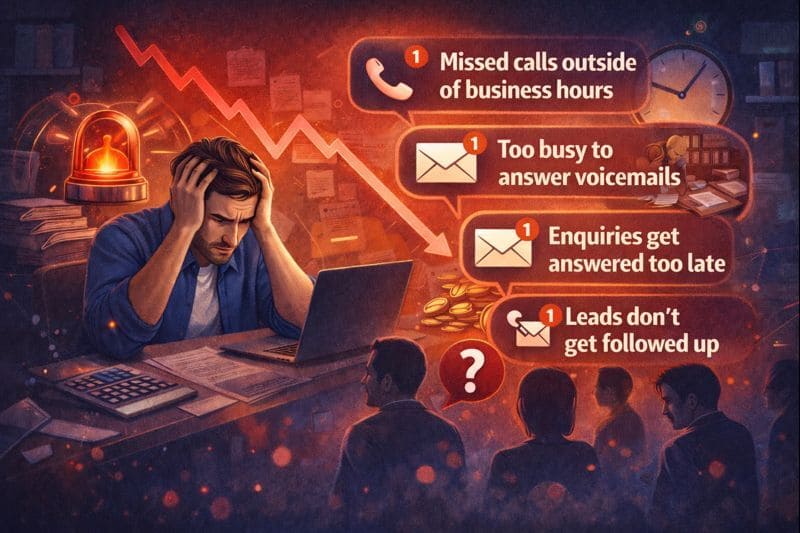
It is a big mistake to ignore small business automation and to assume that doing nothing is the safest option.
For most businesses, the reality is that they already have revenue leaks. These leaks typically look like this: –
- Missed calls outside of business hours
- Too busy to answer voicemails
- Enquiries get answered to late
- Leads don’t get followed up
- Staff are overwhelmed with admin instead of revenue generating work
The list can go on and yet none of these seem dramatic to the typical business owner. The alarm bells are ringing but the business owners can’t hear them. The financial impact this is having is significant and most businesses are not even aware of it because it happens in a stealth like manner. Just this list alone will mean that your business will have lost a significant percentage of the your annual turnover.
Also, it’s not just loss of leads and income. It is also customer perception that gets hit because they think that you can’t be bothered to call them back or your simply not available. That is not a good message.
A smart small business automation strategy will focus on fixing what is already broken and not changing what is working for you.
All of the points mentioned in the list above can be automated in a highly professional manner with zero risk. It is a proven fact that if you just automate the items mentioned in the list above, your annual revenue could well increase between 25% – 30%. If you factor in additional workflow automation, that percentage can increase further.
Starting by automating this list is a “no-brainer”. No risk, yet everything to gain.
The Best Place to Start: Out-of-Hours Call Handling
If you’re curious about automation but still a little unsure, the best step to take initially is to go for out of hours call handling. It is the safest and most effective starting point.
The reason why it is safe and effective is because you have already lost those calls. Nobody answered them. If you have voicemail, mini customers don’t bother leaving a recorded message. They just hang up and you will have lost that potential business.
When your office is closed and the phone rings, most customers move on to call your competition. In many cases, never hear from that customer again.
Automating this part of your business will not interfere with any of your daytime operations. It won’t replace your staff, so no need to worry about that. It simply captures the opportunities that you would otherwise have missed.
A well designed small business automation call system can carry out the following: –
- Answer out of hours calls
- Answer calls 24/7
- Capture caller details clearly and accurately
- Identify if an enquiry is urgent or non urgent
- Book appointments
- Send call summaries to you or your team
From a customer’s perspective, automating these steps provide and increase feel good customer experience. They feel good that they have received a prompt professional response and that things have moved forwards. From your perspective, nothing has changed from how you run your business. If you only want your business automated with calls answered out of hours, then you will have made a great decision that you can build on over time if you wish.
What a Safe Automation Pilot Actually Looks Like
One of the reasons why businesses struggle with automation is because they try to do too much at once.
Our recommended way forwards is to implement a safe and small pilot system that is controlled and reversible.
A small pilot system we’ll typically focus on: –
- One process
- One channel
- One clear outcome
Let’s use out of hours calls that captures enquiries as an example: –
During a pilot phase:
- Clearly defined rules are set in place
- Human oversight is maintained
- Nothing else in the business is touched
Setting up with this approach we’ll build confidence because you will be able to see the results without taking any risks that you might have about automation.
By going down this route, you are not committing to “full automation”, but you are testing a system that solves a specific problem.
When business owners experience the power that this automation can provide, any hesitation to typically quickly fades. The system provides a fully detailed summary of every call, and it collects and Logs the callers details. This allows the business owner to see exactly what they would otherwise have lost, but more than that, they will have a professional log and outline for future reference.
Scaling Small Business Automation Gradually
There seems to be a pattern that we see from business owners that have reservations about automation but are willing to run an initial pilot setup. Fear virtually disappears overnight and turns into curiosity.
So now, the question isn’t “what if this all goes wrong?” business owners often ask, “what else can we automate?”
It doesn’t usually take long for a business owner to be ready to set up the next phase and expand the automation. Scaling at a speed where the business owner is comfortable and relaxed is important. Also, each new automated phase should focus on a single process. It is best to ensure that the business owner can enjoy each setup as a roll out as opposed to an overwhelming change.
The logical next steps for a business to take after out of hours call handling include: –
- Missed call follow-ups (where the staff didn’t answer the call or the call got cut off for whatever reason)
- Booking appointments
- Lead qualification before passing to staff
- Customer review follow-up (to encourage customers to leave a Google review for example).
Automated workflows work best when they are built out alongside the business owners trust as a result of the good experience gained from the automation.
When To Automate at Scale From The Start
We have been talking about rolling out small business automation cautiously, step by step. This advice is purely recommended for business owners that are curious about automation yet hesitant for whatever reason.
If a business owner is all up for automating their business, where they don’t have these reservations, then it would be best to implement the full scale system that meets their needs. The reason why it is best to fully automate the workflows is because the owners can benefit immediately from what the automation provides. These business owners are usually confident in the technology because they have either seen it in operation themselves or they have done their research, so there is no fear present as a result.
Full scale small business automation maximizes revenue income capture. It improves business efficiency. It enables staff to focus on revenue generating tasks as opposed to admin and customer experience is also improved.
Small Business Automation Mistakes to Avoid
As with anything, there are best ways forwards and there are potential mistakes.
With small business automation, the most common mistakes might include: –
- Automating too many processes at once
- Not having a clear and thought out strategy
- Focusing on tech and features instead of practical outcomes
- Removing human touch points to early
A well Thought automated system should feel almost invisible to customers. If customers typically notice that there is automation in place, it will most likely mean that the firm that set up the processes have not implemented then correctly.
Automation Is About Freeing People, Not Replacing Them
We have all heard so called “news” that says that automation is going to replace people’s jobs and we will all be replaced by robots. However, this is not real news. It is hype, written to sell newspapers. What I am talking about in this post is automation that assists staff, not one that replaces them.
In reality, the benefits provided by the automation are appreciated by both the business as well as other staff members. Staff usually don’t like the mundane low value repetitive tasks. Automation can carry these tasks out exceptionally well. This enables staff to work on more interesting tasks that increase self-esteem and job satisfaction. So instead of replacing staff, it enhances the staffs work satisfaction, which is something that most business owners would want to promote in the workplace.
Just think about how much time your team spends doing these things: –
- Answering the same questions stay in day out
- Logging enquiries manually
- Chasing missed calls (if they even do that)
- Handling interruptions while they are focused on other importance tasks
Automation, when done properly, can take on all of these tasks. This typically improves staff morale, increases productivity as well as Revenue.
How to Know If Your Business Is Ready for Automation
It is very easy to know if your aspects of your business operations are ready for automation. First of all, you don’t need to be technical or understand the technical aspects of it. It is a bit like driving a car. You don’t need to understand or know how to strip down a car’s engine in order to drive it and enjoy its benefits. Same with automation, you just need to enjoy the benefits without needing to know the ins and outs of how it works.
Your business is ready if you can identify with any of the following: –
- No one answers the phone out of hours when your business is closed (answer phones do not qualify)
- You miss calls or enquiries for whatever reason
- Growth fields limited because of admin tasks
- You lose business because you didn’t respond to enquiries fast enough
- You are involved in too many day to day tasks
Automation is not just for big corporate businesses. Far from it. Automation and being ready for it is all about where time and or revenue is leaking. Small to medium-sized business desperately need automation, even if they don’t know it yet or have any reservations.
The Smart Next Step: A Simple Automation Discovery Call
If you’re curious about automating aspects of your business, then we would love to hear from you. We would be more than happy to jump on a Zoom call to discuss your requirements and put together a custom strategy for you. There is no obligation and it is a free consultation. Just click the link below and select a time and date for the call: –
Click to Arrange Your Discovery Call
Also, if you are curious but have reservations or cautious about getting it wrong, the best next step is to have a no obligation call with us where we can talk to you about your business or any concerns that you might have about automation. A short Discovery call will allow us to identify the following: –
- Discover where opportunities are being missed or lost
- Recommend a safe, low risk starting point
- Decide what not to automate yet
- Design and automation pilot that is custom-built to your business
As I said, there is no obligation and no pressure for you to proceed. The goal for our call is to provide you with clarity and not commitment.
Whatever your position, if you want to explore automation in a way that feels controlled, safe, practical and aligns with how your business actually works, then a discovery call will provide you with that.
Action Steps
Click the link below and book an appointment call. It will be a professional, zero pressure where we can calmly and strategically identify areas of your business that could benefit from automation and where we can put together a well thought out customized strategy that is perfect for you.